Original presentation by Dr. Amanda Heim
Adapted for Music Theory IV by Dr. Avner Dorman | Spring 2026
Defining Pulse and Beat
When we listen, we often notice several possible timing levels: a faster one, a slower one, and sometimes something in between. These layers form a hierarchy of timing levels.
The beat is the pulse level (or organization of pulse into hierarchical levels) that becomes metrically important - the level we most naturally move or tap along with. It emerges when pulse is organized into a hierarchical pattern of strong and weak positions, typically reinforced by accents, patterns, or the way the music is performed. In symmetric meters, the beat often directly corresponds to one pulse level; in asymmetric meters, the beat may group pulses of unequal duration (e.g., in 7/8, one beat might span three eighth notes while others span two).
In conducted music, the conductor shows the beat level to the ensemble. The conducting pattern tells performers which pulse layer should function as the beat.
Listening for Beat Level
Identify the beat level by determining the primary hierarchical layer of temporal organization.
Example 1: The Beatles, "Back in the USSR"
Example 2: The Duke Ellington Orchestra, "Ko-Ko"
Metrical Hierarchy
Once we feel the beat, we can often sense other steady layers. These may feel like smaller or larger durations, but they are all connected to the same pulse.
The metrical hierarchy comprises multiple timing levels, including the beat, divisions of the beat, and larger cycles (measures).
The beat level can be broken down into smaller durations called the division level.
Try It: Detecting Multiple Levels
Listen: Joni Mitchell, "Help Me"
Identify the beat, then observe how smaller divisions articulate within it and how longer spans combine multiple beats into broader metrical cycles.
Simple Meter
Now that we understand the beat and its smaller durations (division level), we can describe how the music groups these beats into a repeating pattern. This pattern is the meter.
Important: A simple meter can have any number of beats. The term "simple" describes that the beat level divides into two division level parts.
Compound Meter
Not all beat levels divide into groups of two.
Important: A compound meter can have any number of beats. The term "compound" describes that the beat level divides into three division level parts.
Try It: Hearing Compound Meter
Listen: Horace Silver Quintet, "Señor Blues"
Tap the beat level, then determine the division level. Is it in groups of 2 or 3?
Pattern of Accents
In Week 1, we grouped pulses. Now, we listen for groupings at the beat level, because this is what defines the meter.
Along with the division level, we must also determine the grouping of beats in music in order to determine the meter.
Listen for the pattern of accented and unaccented beats.
Types of Accents
There are three types of accents: phenomenal, structural, and metrical.
A phenomenal accent can occur in many ways:
- Written accent (>)
- Extreme in register (very high or very low note)
- Extreme in note length (very short or very long)
- Change in instrumentation (added instrument)
Duple Meter
In much jazz and popular music, we hear a regularly occurring phenomenal accent every other beat.
This series of accents (accented-unaccented) illustrates that the meter is duple.

Listening Tip
In jazz and popular idioms, percussion patterns—specifically the placement of the snare and hi-hat—frequently delineate the metrical structure.
There is often a cymbal (hi-hat) or snare drum hit every other beat in a duple meter.
Example: Duple Meter
Listen: Count Basie Orchestra, "That Warm Feeling"
Can you hear the snare/cymbal accenting every other beat?
Triple Meter
Some music accents the beat level every third beat.
We describe this meter as triple.

Example: Triple Meter
Listen: Jazz at Lincoln Center Orchestra, "Basque Song"
Can you feel the pattern of 3?
Summary
Meter Signatures
In Simple Meters
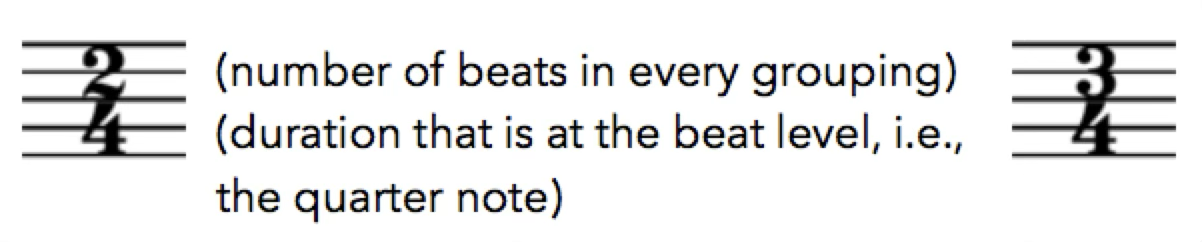
Top number: indicates the number of beats per measure.
Bottom number: describes the duration of note that is at the beat level
In Compound Meters
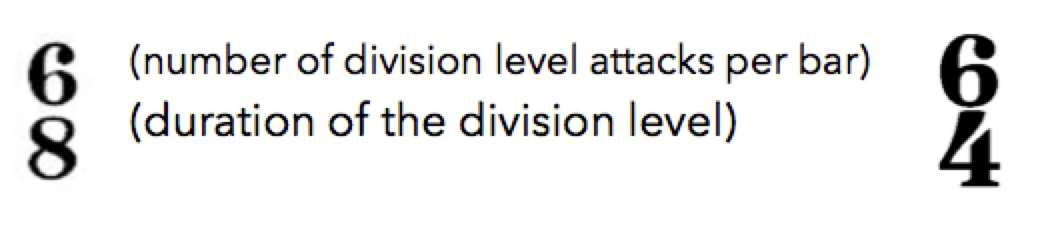
Top number: describes the number of division level attacks present in each measure
Bottom number: describes the duration of note at the division level
Quick Reference
Simple meter: Top number = how many beats | Bottom number = what note gets the beat
Compound meter: Top number = how many divisions | Bottom number = what note is one division
Meter signatures summarize both the division structure and the metrical structure we just explored.