Hocket is the rapid exchange of single notes or tiny fragments between two or more voices so a melody sounds like it is bouncing around the ensemble. Medieval theorists called it hoquetus—Latin and Old French for “hiccup.”
In practice, one line is split into alternating events: Voice A handles beats 1, 3, 5… while Voice B fills 2, 4, 6… At slow tempos you clearly hear trades; at fast tempos the listener perceives a seamless single line infused with rhythmic interest.
Hear It First
Clap a Two-Person Hocket
Grab a partner and try this eight-pulse loop.
Person A: X . . X . . X .
Person B: . X . . X . . X
Together: X X . X X . X X
Start slowly so each player owns their beat numbers.
Speed it up.
Swap roles to feel the opposite half of the grid.
Try It Yourself
Activity 1: Five-Note Scale
A five-note ascending line becomes one fluid idea when two singers alternate notes.
Full Melody: C–G
Voice 1 (beats 1–3–5)
Voice 2 (beats 2–4)
Each singer focuses on their cue numbers, but the audience perceives one steady five-note gesture.
Activity 2: “Mary Had a Little Lamb” Fragment
Split a familiar tune to test coordination. We alternate every note so both voices see the full rhythm but only perform half of the events.
Original Melody
Voice 1
Voice 2
Challenge: rehearse until both lines breathe together and consonants land in sync. Once the handoff becomes effortless, increase the tempo.
Interactive Hocket Splitter
This tool takes any short ABC melody and splits every other note into a complementary hocket. Voice 1 follows the pattern 1 0 1 0… while Voice 2 automatically receives the opposite 0 1 0 1…. Durations stay intact—only the performer assignment changes.
Default alternates every note. Enter “1,1,0,0” to trade every two notes, etc.
Voice 1 Output
Voice 2 Output
Medieval Rhythmic Modes & Hocket
In the 13th century, composers at the Notre Dame school used a system of six rhythmic modes—repeating patterns of long (L) and breve (B) note values. Hocket was created by inserting rests into these pre-set patterns, with two voices alternating to create the complete rhythm.
Table 1: The Rhythmic Modes
Mode
Note Values
Time Units per Note
1.
L B, L B, L B, etc.
2 1, 2 1, 2 1, etc.
2.
B L, B L, B L, etc.
1 2, 1 2, 1 2, etc.
3.
L B B, L B B, etc.
3 1 2, 3 1 2, etc.
4.
B B L, B B L, etc.
1 2 3, 1 2 3, etc.
5.
L, L, L, etc.
3, 3, 3, etc.
6.
B B B, B B B, etc.
1 1 1, 1 1 1, etc.
Note: L = Long, B = Breve. Time units show the relative duration of each note.
Table 2: How Hocket Works in the Rhythmic Modes
Early 13th-century hocketing was limited to modes 1, 2, and 5. The following examples show normal (complete) rhythmic passages compared with their hocketed versions, where two voices alternate to create the same overall pattern.
Mode 1: L B, L B pattern becomes two interlocking voices
Normal phrase: L B L rest (continuous in one voice)
Hocketed:
Voice 1: L rest L rest
Voice 2: rest B rest B
Mode 2: B L, B L pattern becomes alternating voices
Normal phrase: B L B rest (continuous in one voice)
Hocketed:
Voice 1: B rest B rest
Voice 2: rest L rest L
Mode 5: L, L, L pattern with interlocking
Normal phrase: L L L rest (all longs)
Hocketed:
Voice 1: L rest L rest
Voice 2: rest L rest L
Key Insight: Hocketing transforms a single melodic line into a dialogue between voices. Each voice rests while the other sounds, creating rhythmic energy and textural interest. This technique connects directly to the isorhythmic procedures we studied earlier this week—both involve systematic fragmentation and recombination of musical material.
Historical Lineage
Medieval Ars Nova (13th–14th centuries)
Guillaume de Machaut’s motets use rapid alternation among two or three voices.
Mensural notation allowed talea and color patterns to separate and recombine freely.
Listen for a hiccup-like sound as tenor and motetus trade single notes.
Historical usage
Hocket (Latin hoquetus, Old French hoquet—“hiccup” or “sudden interruption”) named a precise contrapuntal device in 13th–14th-century motets and cantilenae. Medieval composers split a single melodic strand across two or more voices so that one sounds while another rests, creating an audible interruption effect.
The alternation in surviving sources often spans short passages rather than entire movements, and the pace is not always lightning fast. Later writers extend the term to modern interlocking textures, but the medieval definition centers on those brief, hiccup-like exchanges.
Example: Machaut Motet Hocket
Hear the interlocking voices at work in this Ars Nova motet excerpt. Notice how individual syllables pop across the texture while the composite line stays uninterrupted.
20th-Century Revival
Louis Andriessen - Hoketus (1976)
Anton Webern - Reicercar a 6 (1935) based on Bach’s The Musical Offering (BWV 1079)
Meredith Monk - Hocket from Facing North (1990)
Global and Popular Traditions
Ugandan amadinda xylophone ensembles divide timelines among multiple players.
Minimalist synth and electronic artists (Aphex Twin, Autechre) program interlocking sequences.
Film and game scores borrow these textures for kinetic ostinati.
Machaut's Hoquetus David: The Piece in Depth
The Hoquetus David is not just an example of hocket technique — it is the only surviving 14th-century piece composed entirely as a standalone hocket. Daniel Leech-Wilkinson's 1980 analysis reconstructs, from evidence inside the score itself, the likely step-by-step procedure by which Machaut composed it. What follows traces that argument through the score.
The Score: Three Voices, One Interlocking Line
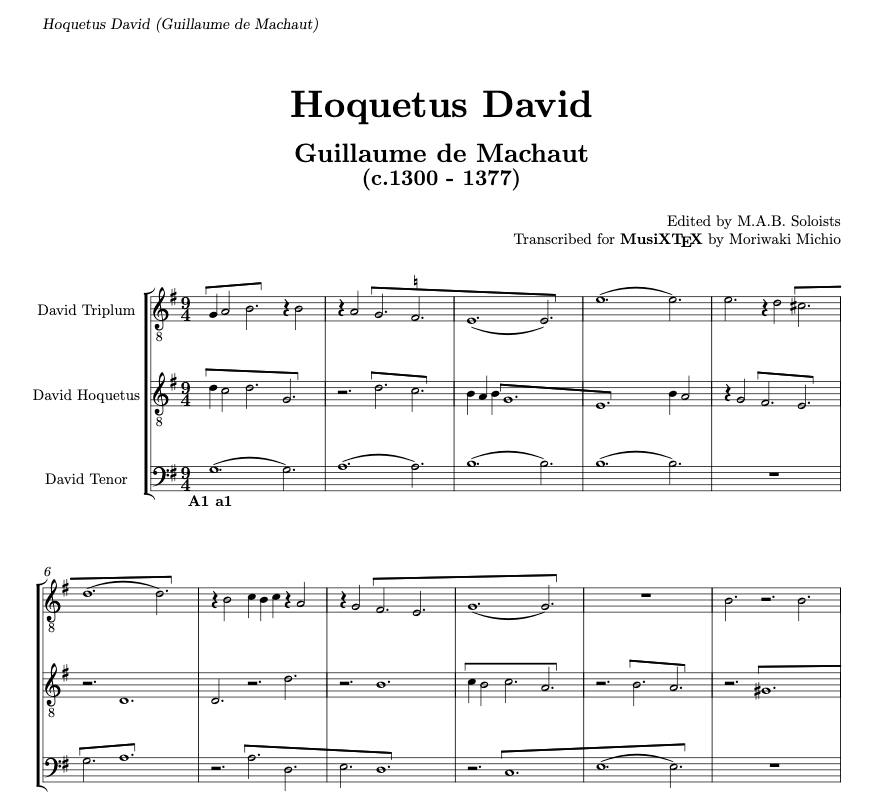
The piece is written for three voices: Triplum (top), Hoquetus (middle), and Tenor (bottom). The tenor moves in long, slow note values drawn from a Gregorian chant melisma; the upper two voices trade notes and rests in rapid alternation — the hocket texture itself.
Machaut, Hoquetus David, mm. 1–12 (ed. M.A.B. Soloists / Moriwaki Michio). The alternating rests and notes in the Triplum and Hoquetus voices create the characteristic hiccup texture. Section label A1 a1 marks the start of the first talea and first color.
Notice already in these opening bars how the Triplum and Hoquetus rarely sound simultaneously — one moves while the other rests. Together they create what sounds like a single continuous melodic line.
1. The Isorhythmic Foundation
Medieval theory (Franco of Cologne) required any hocket to be built on a cantus prius factus — a pre-existing melody. Machaut's source is the final melisma on the word "David" from the Alleluia verse Nativitas gloriose virginis. He organizes this 32-note chant fragment isorhythmically: repeating it in a fixed rhythmic pattern (talea) across multiple pitch statements (color).
The piece divides into two large sections with a 3:1 ratio of colores:
Section A — three statements of the chant (colores), subdivided into eight taleae of 12 notes each; the talea boundaries cross the color boundaries unusually
Section B — one color, divided into four taleae of 8 notes each; simpler rhythm, settling rather than energizing the close
Section A = 88 bars. Section B = 35 bars. These numbers will matter.
2. Rhythmic Cells: The Building Blocks
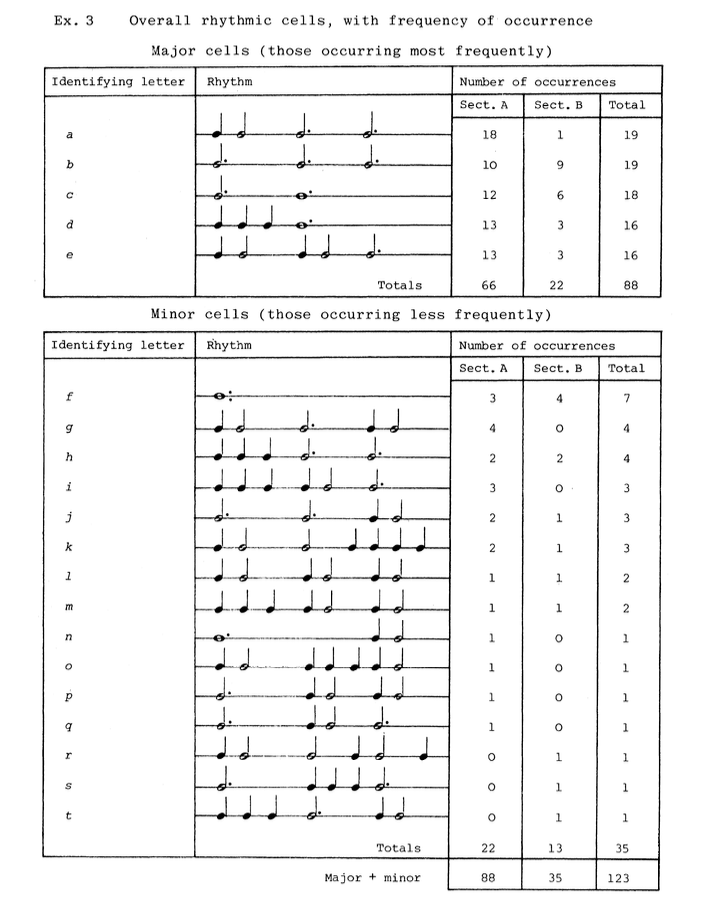
Rather than analyzing each voice in isolation, Leech-Wilkinson examines the combined rhythm of all three voices together — the pattern of attacks across the entire texture at any given moment. This yields a vocabulary of just 20 distinct rhythmic cells, labeled a through t.
The table below (Ex. 3 from the article) catalogues all 20 cells with their frequency of occurrence in each section:
Leech-Wilkinson (1980), Ex. 3: The 20 rhythmic cells of the Hoquetus David, divided into five "major" cells (top) and fifteen "minor" cells (bottom), with occurrence counts for Sections A and B.
The proportional relationships that emerge are striking:
The five major cells appear exactly 88 times — the number of bars in Section A
The fifteen minor cells appear exactly 35 times — the number of bars in Section B
The ratio of major to minor cell occurrences is 3:1 — the same as the ratio of colores between the two sections
Leech-Wilkinson argues this cannot be coincidence. Machaut appears to have built the rhythmic structure of the piece to mirror its macro-level proportions in miniature.
3. How the Piece Looks in Cell-Letter Notation
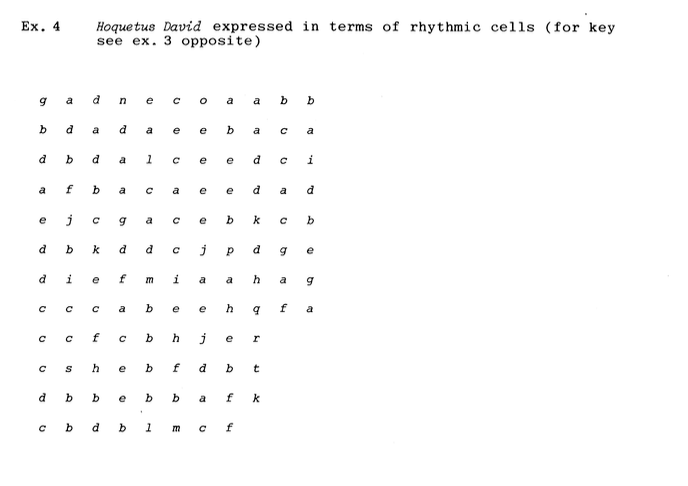
Ex. 4 from the article encodes the entire piece bar-by-bar as a sequence of cell letters. Reading through it, you can see the vocabulary is tight — the same handful of cells recur constantly, while rare cells appear only once or twice:
Leech-Wilkinson (1980), Ex. 4: The full piece expressed in terms of rhythmic cells. Each letter corresponds to one bar. The high frequency of a, b, c, d, and e (the major cells) is immediately visible.
The f cells (simultaneous full-bar rests in all three voices) function as structural pillars — placed at mathematically regular intervals to mark large-scale divisions, their long note values make them audible landmarks for the listener.
4. One Cell, Many Realizations
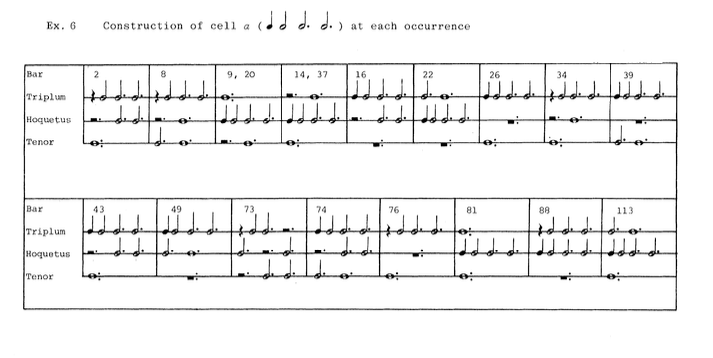
A single rhythmic cell in the combined texture can be distributed between the voices in many different ways. Cell a — the most common cell — appears in 17 different voice configurations across the piece. Ex. 6 from the article shows all of them:
Leech-Wilkinson (1980), Ex. 6: Every occurrence of cell a in the piece, showing how the same combined rhythmic pattern is realized differently across the Triplum, Hoquetus, and Tenor at each bar.
This flexibility is what allows Machaut to maintain the strict proportional cell-count while also achieving near-perfect balance of sound and silence across the three voices — each voice ends up with approximately the same total duration of notes (~98½ longae) and rests (~24½ longae).
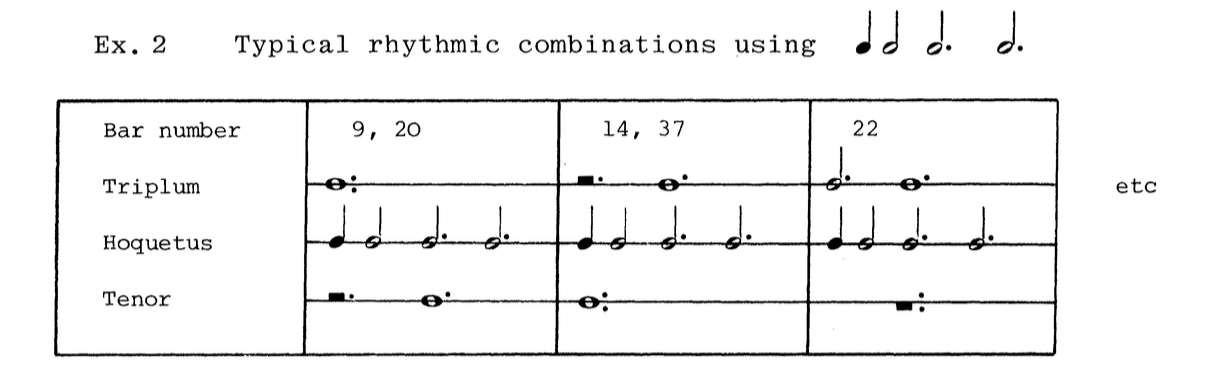
5. How Typical Combinations Work
Ex. 2 from the article zooms in on one specific rhythmic pattern and shows how it is distributed across bars where it recurs — illustrating that the same cell-level rhythm can appear with different vertical combinations depending on which voice carries which note:
Leech-Wilkinson (1980), Ex. 2: A single rhythmic pattern shown at multiple bars, with the three voices (Triplum, Hoquetus, Tenor) taking different roles each time.
6. The Proposed Compositional Order
Leech-Wilkinson synthesizes the analysis into four likely compositional stages:
Tenor first — arrange the chant melisma into colores and taleae, establishing the isorhythmic skeleton
Structural pillars — place the f cells (full simultaneous rests) at mathematically determined positions
Rhythmic scheme — distribute the remaining cells in the predetermined 3:1 proportions across the full length of the piece, then assign them to voices according to complexity hierarchy (more complex, rest-filled patterns to the Triplum; simpler patterns to the Hoquetus)
Pitches last — compose the Hoquetus voice first (it provides the harmonic foundation together with the Tenor), then the Triplum — the medieval practice of "successive composition"
This sequence aligns with the description in Johannes Grocheo's treatise (c. 1330): compose a monophonic line, divide it between voices, then add overlapping material so the voices interlock.
Significance: The Hoquetus David is unusual precisely because its compositional logic is so transparent — the numbers line up too neatly to be accidental, giving us a rare window into how a 14th-century composer thought about musical coherence. Machaut unified the piece through symbolic numerical proportions, rhythmic economy, and the careful balance of sound and silence across independent voices.
African Hocketing Traditions
Hocket technique appears in musical traditions across Africa, where interlocking patterns are fundamental to ensemble music-making. In this example of Ugandan flute hocketing, multiple players each contribute individual notes that interlock to create a complete melody—demonstrating that this technique predates and likely influenced medieval European practices.
Listen for how each musician plays only their assigned pitches, yet the composite result is a flowing, continuous musical line:
Types of Hocket
Single-Note Hocket
Voices alternate every note: Voice 1: C . E . G . Voice 2: . D . F . A
Phrase Hocket
Larger chunks swap between parts so each fragment breathes before the handoff.
Overlapping Hocket
Entries overlap slightly, creating a denser counterpoint that still outlines a single contour.
Color (Timbre) Hocket
Identical rhythms move through changing timbres for kaleidoscopic orchestration effects.
Connections to Other Techniques
Isorhythm: Medieval composers used hocket within isorhythmic structures, splitting the talea so different voices cover different parts of the repeating pattern. Both techniques involve systematic fragmentation and recombination of musical material.
Polyrhythm: Offset hocketing voices into different meters for cross-rhythmic effects.
Timelines: West African bell and drum pairs function like interlocking patterns that outline the groove, demonstrating the global presence of hocket-like techniques.
Unit Review: Rhythm Concepts (Weeks 1-4)
This hocket lesson concludes our four-week exploration of rhythm. Use this review to prepare for your unit test, which covers all the concepts below.
Week 1: Pulse and Grouping
Pulse: Evenly spaced temporal points that are constant, neutral, and serve as reference for all other musical events
→ Review: Music in Time - Pulse
Defining Rhythm: Contrasting features (accents, tone colors, durations) organized in time; Types A through E progression
Time Signatures: Simple vs. compound vs. complex meters; beaming conventions
Timelines: Asymmetric repeating patterns that orient ensemble music (tresillo, son clave, rumba clave, bossa nova)
Week 3: Euclidean Rhythms and Geometry
Euclidean Algorithm: E(n,k) distributes k onsets across n pulses as evenly as possible
Maximally Even Rhythms: Mathematical approach to creating balanced rhythmic patterns
Interval Vectors: Analyzing timeline patterns by measuring distances between onsets
Week 4: Isorhythm, Metric Modulation, and Hocket
Isorhythm: Medieval technique separating repeating rhythm (talea) from repeating melody (color); used by Machaut, Dufay, and 20th-century composers like Messiaen
Metric Modulation: Tempo changes created by reinterpreting note values (e.g., old 1/6 = new 1/4)
Hocket: Interlocking voices that alternate to create a single melodic line; found in medieval rhythmic modes and African traditions
Test Preparation Tips
Review all concept pages linked above
Practice Euclidean rhythm calculations: E(5,12), E(7,16)
Practice metric modulation calculations with the formula
Know interval vector analysis for timelines
Understand the difference between simple, compound, and complex meters
Be able to explain: pulse vs. meter, timeline vs. ostinato