What Is Pitch?
You've been working with pitch your entire musical life—singing it, playing it, hearing it. But what actually is pitch? How does a vibrating string or column of air produce the sensation we call "middle C" or "A440"?
For the past four weeks, we've been working with rhythm: pulses, groupings, polyrhythms, and timelines. Now we're going to bridge from rhythm to pitch by exploring a fundamental acoustic fact: pitch is fast rhythm.
Pitch as Frequency
When a periodic vibration occurs fast enough (roughly 20-20,000 times per second), we perceive it as pitch rather than as individual pulses. The rate of vibration is called frequency, measured in Hertz (Hz) = cycles per second.
Interactive Demonstration: Speeding Up Rhythm
Let's experience this transformation from rhythm to pitch. We'll start with a slow, audible pulse (like the ones we worked with in Week 1), then gradually speed it up until it becomes a pitch.
Pulse Speed Controls
Current state: Individual pulses
What to Listen For
- 0.5-10 Hz: Individual pulses (like Week 1)
- 10-20 Hz: Transition zone (flutter/buzz)
- 20+ Hz: Definite pitch emerges
- 440 Hz: The note A4 (standard tuning reference)
Notice that there's no sharp boundary between rhythm and pitch—it's a continuum. What we call "rhythm" and what we call "pitch" are the same physical phenomenon operating at different speeds.
Definite vs. Indefinite Pitch
Not all sounds create a clear sense of pitch. The difference lies in whether the vibration is periodic (regular, repeating pattern) or aperiodic (irregular, noisy).
Pitch Types
Definite pitch: Produced by periodic vibrations with a clear, stable fundamental frequency. Examples: flute, voice, guitar strings.
Indefinite pitch: Produced by aperiodic or complex vibrations without a clear fundamental frequency—many frequencies present simultaneously with no single one standing out. Examples: snare drum, crash cymbal, white noise.
Interactive Comparison
Sine wave: The simplest periodic vibration—a single pure frequency.
Complex periodic: Multiple frequencies in harmonic relationship (fundamental + overtones)—sounds musical.
Noise: Random, aperiodic vibrations—no clear pitch.
Musical instruments produce complex periodic waveforms: a fundamental frequency plus harmonically-related overtones. The difference in sound between instruments playing the same pitch (called timbre) comes from multiple factors: the strength and distribution of overtones (spectral envelope), how the sound begins and ends (attack and decay), and subtle variations in vibrato and intonation. A clarinet playing A440 has the same fundamental frequency as a violin playing A440, but different overtone patterns—this is why they sound distinct even when playing the same note.
Further Reading on Timbre
For more on acoustic properties of musical instruments and timbre perception, see:
- Helmholtz, H. (1877). On the Sensations of Tone (classic text on acoustics)
- Campbell, M. & Greated, C. (1987). The Musician's Guide to Acoustics
- Online resource: Physics of Music (UNSW Sydney)
Polyrhythms Become Intervals: Ratios and Consonance
Remember the polyrhythms from Week 1? When we played 2 against 3, or 3 against 4? Those same simple integer ratios create consonant musical intervals when applied to pitch frequencies.
Frequency Ratios = Intervals
When two pitches have frequencies in a simple integer ratio, we hear a consonant interval:
| Ratio | Interval Name | Connection to Rhythm |
|---|---|---|
| 2:1 | Octave | Like 2:1 grouping |
| 3:2 | Perfect Fifth | Like 3:2 hemiola |
| 4:3 | Perfect Fourth | Like 4:3 polyrhythm |
| 5:4 | Major Third | Like 5:4 polyrhythm |
| 6:5 | Minor Third | Like 6:5 polyrhythm |
The 3:2 Ratio in Action
Watch how a 3:2 polyrhythm (from Week 1) transforms into a perfect fifth interval:
This connection between polyrhythm and interval is profound: the same mathematical relationships that create rhythmic patterns also create harmonic relationships. A 3:2 polyrhythm and a perfect fifth are the same structure at different speeds.
Consonance and Ratio Complexity
Simple ratios (2:1, 3:2, 4:3): The frequencies align frequently, creating stable, consonant intervals. When played together, they blend smoothly.
Complex ratios (16:15, 45:32): The frequencies align rarely, creating beating and dissonance. This is the same principle as complex polyrhythms—they don't align as often!
Naming Pitches and Octave Registers
Now that we understand pitch as frequency, we need a system for naming specific pitches. Western music uses a combination of letter names and octave numbers.
Pitch Naming System
Letter names: C, D, E, F, G, A, B (plus sharps ♯ and flats ♭)
Octave numbers: C4 = "middle C" (approximately 262 Hz)
The number changes at each C. So: ...B3, C4, D4, E4...B4, C5, D5...
The Chromatic Scale
Between any two adjacent letter names (except E-F and B-C), there's a pitch exactly halfway in between. This creates the 12-note chromatic scale:
C — C♯/D♭ — D — D♯/E♭ — E — F — F♯/G♭ — G — G♯/A♭ — A — A♯/B♭ — B — (C)
Why 12 Notes?
The 12-tone equal temperament system divides the octave (2:1 ratio) into 12 equal logarithmic steps. This allows us to transpose music to any key while maintaining the same interval relationships. It's a compromise—most intervals are slightly out-of-tune from pure frequency ratios (except the octave), but they sound consistent and acceptable in all keys. This consistency was crucial for keyboard instruments and later for orchestral and ensemble music.
Octave Equivalence
Pitches separated by octaves (2:1 frequency ratio) sound fundamentally similar. C4 and C5 are both "C" in an important perceptual sense, even though they're in different registers.
This equivalence relationship is foundational to pitch-class theory, but it's important to understand that equivalence does not mean identity. C4 and C5 are distinguishable—they occupy different registers and have different acoustic properties—but they share a common pitch-class identity.
Example 1: Schoenberg, Two Equivalent Melodies from String Quartet no. 4
Original Melody (from opening)
Octave Displaced Version (from later in movement)
The two passages present the same pitch-class content but in different octave registers. When we analyze them as pitch classes (rather than specific pitches), the melodic structure becomes identical. Click play on each version to hear how the same pitch classes sound different when placed in different octaves. The connecting lines above show how each note in the original melody corresponds to a note in the displaced version—same pitch classes, different octaves.
Octave Displacement as a Compositional Technique
Understanding octave equivalence is crucial for analysis because it reveals octave displacement—a compositional technique where pitches are intentionally moved to different octaves. Composers and improvisers use octave displacement to:
- Create melodic interest and avoid predictable patterns
- Achieve specific registral effects or timbres
- Distribute pitch material across different instruments or voices
- Generate variety from limited pitch-class material
- See the underlying structure when you reduce a passage to its pitch classes
- Recognize why two passages with the same pitch classes sound different—octave displacement is often the reason
- Understand what the composer did intentionally
Interactive Example: Octave Displacement
Below are two versions of the same melodic pattern. The first presents a simple ascending scale. The second uses octave displacement—the same pitch classes appear in the same order, but some notes jump to different octaves, creating a more interesting melodic contour.
Version 1: Simple Ascending Pattern (No Displacement)
Version 2: Same Pitch Classes with Octave Displacement
What to Notice
Both versions use the same eight pitch classes in the same order: C, D, E, F, G, A, B, C. But the displaced version sounds more unpredictable and interesting because pitches appear in different octaves. This is a common technique in 20th-century composition and jazz improvisation.
When analyzing music, recognizing octave equivalence helps you see that these two passages are structurally related, even though they sound quite different.
Example 2: Many Pitches but only three Pitch Classes (Morton Feldman Durations III)
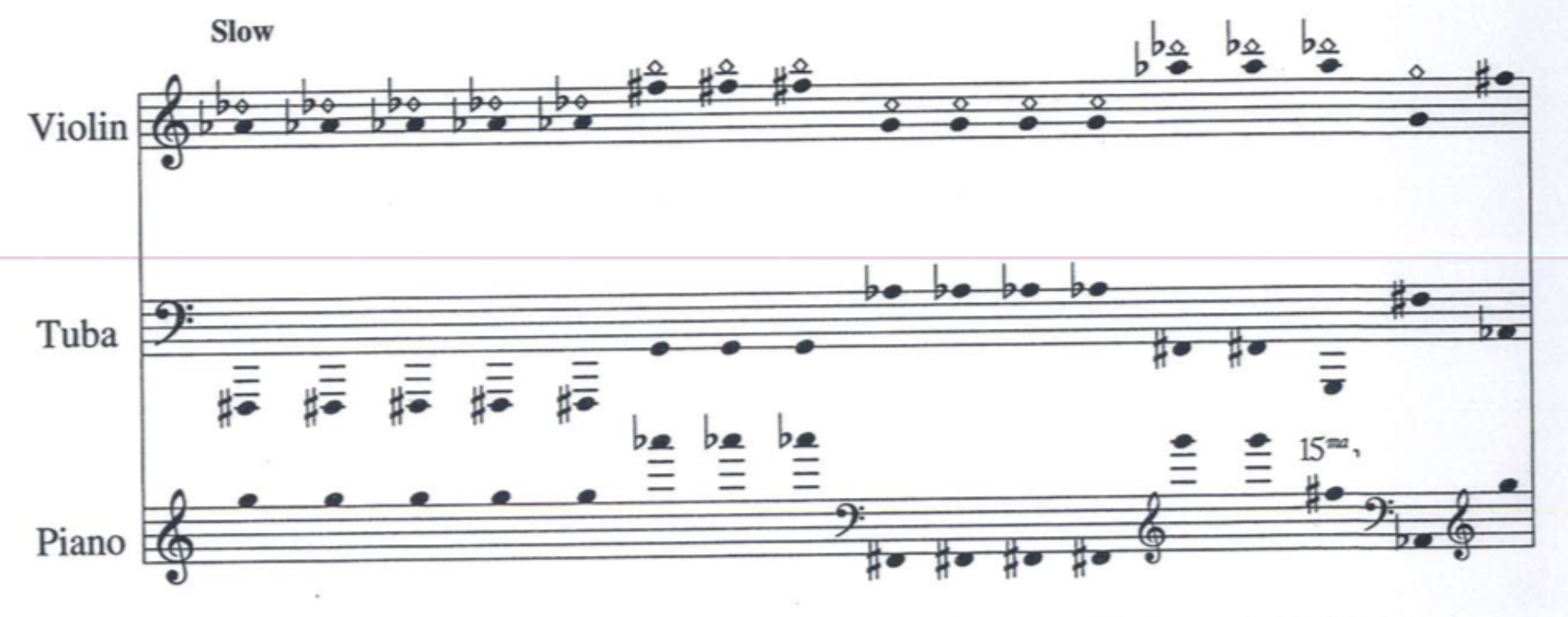
This passage uses many different pitches spread across a wide register, but only three pitch classes: F♯, G, and A♭. Analyzing the pitch classes reveals the structural simplicity beneath the registral complexity—an example of extreme octave displacement creating variety from minimal pitch-class material.
Enharmonic Equivalence
In equal temperament, pitches that sound identical but have different names are called enharmonic equivalents. For example, C♯ and D♭ produce the same frequency on a piano.
Enharmonic pairs:
- C♯ = D♭
- D♯ = E♭
- F♯ = G♭
- G♯ = A♭
- A♯ = B♭
- E♯ = F, B♯ = C, F♭ = E, C♭ = B
In tonal music, enharmonic spelling reflects harmonic function. In post-tonal analysis, we often treat enharmonic equivalents as the same pitch class.
Pitch Class: Abstracting Away Register
Often in analysis, we care about the identity of a note (is it a C? an F♯?) but not its specific register. This is where the concept of pitch class becomes useful.
Pitch vs. Pitch Class
Pitch: A specific note with a defined frequency and register. Examples: C4 (262 Hz), F♯5 (740 Hz), B♭3 (233 Hz)
Pitch Class (PC): A class of pitches related by octave and enharmonic equivalence. Examples: C, F♯, B♭
Think of pitch class as a category. The pitch class C includes C0, C1, C2, C3, C4, C5, C6, C7, C8, as well as B♯ in any octave and D𝄫 in any octave. They're all the same pitch class despite being different pitches.
When to Use Pitch vs. Pitch Class
Analytical Decisions
Use "pitch" when register matters: melodic contour, voice leading, specific instrumentation
Use "pitch class" when analyzing harmonic content, collections, symmetries, or transpositional relationships
Example: Feldman, Durations III, No. 3
This passage uses many different pitches spread across a wide register, but only three pitch classes: F♯, G, and A♭. Analyzing the pitch classes reveals the structural simplicity beneath the registral complexity.
Integer Notation for Pitch Classes
To work with pitch classes mathematically, we assign each one an integer from 0 to 11. This system allows us to perform calculations and identify patterns.
The Twelve Pitch Classes
| Integer | Pitch Class |
|---|---|
| 0 | C, B♯, D𝄫 |
| 1 | C♯, D♭ |
| 2 | D, C𝄪, E𝄫 |
| 3 | D♯, E♭ |
| 4 | E, F♭ |
| 5 | F, E♯ |
| 6 | F♯, G♭ |
| 7 | G, F𝄪 |
| 8 | G♯, A♭ |
| 9 | A, G𝄪 |
| 10 | A♯, B♭ |
| 11 | B, C♭ |
Why C = 0?
The choice of C = 0 is conventional. The key point is consistency: once you choose C = 0, the rest follows chromatically. Some theorists use movable zero (where the "tonic" = 0), but we'll use fixed zero throughout this course.
Notation Conventions
We use integers 0-11. Some texts use T and E for ten and eleven to keep single-character notation, but we'll use 10 and 11 for clarity.
Mod 12 Arithmetic
Since we have 12 pitch classes that repeat cyclically, we use modulo 12 arithmetic to handle calculations that might go beyond 11 or below 0.
Modulo 12 (mod 12)
Modulo 12 arithmetic means we "wrap around" after 11, just like hours on a clock.
Formula: n mod 12 = remainder when n is divided by 12
Examples of Mod 12 Calculation
- 13 mod 12 = 1
- 25 mod 12 = 1
- −1 mod 12 = 11
- −5 mod 12 = 7
The Pitch-Class Circle
We can visualize pitch classes arranged like hours on a clock. This representation helps us understand mod 12 arithmetic and see relationships between pitch classes.
Clock Face Thinking
Moving clockwise = adding pitch classes
Moving counter-clockwise = subtracting pitch classes
All arithmetic "wraps around" at 12
Intervals in Pitch-Class Space
Now that we have a system for labeling pitch classes, we can define intervals between them. Pitch-class intervals are simply the distance between two pitch classes, measured in semitones.
Ordered Pitch-Class Intervals
Ordered Pitch-Class Interval
The ordered pitch-class interval from pitch class x to pitch class y is:
(y − x) mod 12
This tells us how many semitones to move clockwise on the pitch-class circle to get from x to y.
Calculating Ordered PC Intervals
- From C♯ (1) to E♭ (3): (3 − 1) mod 12 = 2
- From E♭ (3) to C♯ (1): (1 − 3) mod 12 = 10
- From B (11) to F (5): (5 − 11) mod 12 = 6
Unordered Pitch-Class Intervals
Unordered Pitch-Class Interval
The unordered pitch-class interval between x and y is the smaller of the two ordered intervals. This gives us the shortest distance, ranging from 0 to 6.
Calculating Unordered PC Intervals
- Between C♯ (1) and E♭ (3): min(2, 10) = 2
- Between B (11) and F (5): min(6, 6) = 6
- Between D (2) and B♭ (10): min(8, 4) = 4
Relationship to Traditional Intervals
| Unordered PC Interval | Traditional Name(s) | Semitones |
|---|---|---|
| 0 | Unison, octave | 0, 12, 24... |
| 1 | Minor 2nd | 1, 13, 25... |
| 2 | Major 2nd | 2, 14, 26... |
| 3 | Minor 3rd | 3, 15, 27... |
| 4 | Major 3rd | 4, 16, 28... |
| 5 | Perfect 4th | 5, 17, 29... |
| 6 | Tritone | 6, 18, 30... |
Summary: From Rhythm to Pitch-Class Theory
Today we've built a bridge from the rhythmic concepts of Weeks 1-4 to pitch-class theory:
- Pitch is fast rhythm: Frequency = pulses per second
- Ratios connect polyrhythm to intervals: 3:2 polyrhythm = perfect fifth
- Pitch class: Notes grouped by octave and enharmonic equivalence
- Integer notation: 12 pitch classes labeled 0-11
- Mod 12 arithmetic: Calculations that wrap around like a clock
On Wednesday, we'll explore common pitch-class collections (whole-tone, octatonic, pentatonic) and see these concepts in musical context.