Introduction
In post-tonal theory, we work with Pitch Class Sets—unordered collections of pitch classes. You can think of a pitch class set like a magic backpack. It contains only the pitch classes in the set, and whenever you pull one out and use it, it gets replaced instantly. You have an infinite supply of each pitch class inside, but only those pitch classes—nothing else.
The magic backpack has two buttons on it: a Transposition button (Tn) and an Inversion button (In). When you press either button, all the pitch classes inside instantly change—but the internal structure is preserved. The Interval Class Vector stays the same.
The specific notes change, but the relationships between them—the interval class vector—remain identical.
1. Transposition (Tn)
Transposition of a Line of Pitches
- Traditionally, transposition refers to transposing a line (or series) of pitches.
- When we transpose a melody from one key to another, we transpose each pitch, in order, by some pitch interval.
- This preserves the ordered pitch intervals in the melody (its contour—the shape of ups and downs).
- Because contour is such a basic musical feature, it is easy to recognize when two lines of pitches are related by transposition.
Transposition of a Line of Pitch Classes
- Things are different when we transpose a line of pitch classes rather than pitches.
- We transpose each pitch class by some pitch-class interval (an integer mod 12).
- The result will not necessarily sound similar to the original line or be easily recognizable—because pitch classes have no specific octave, the concept of contour disappears.
- Transposition of pitch classes is done using addition mod 12.
Interactive Demo: Line vs. Set
Ordered Melody (Contour Preserved)
Pitch Class Set (Contour Lost)
[ 0, 1, 3, 6, 7, 9 ]
Transposing a Pitch Class Set
A pitch class set is unordered—it's just a collection of pitch classes. To transpose a pitch class set, simply add a single pitch-class interval (a number) to each member of the set, mod 12.
Key Insight
Pressing the Tn button changes every pitch class inside, but preserves the interval structure—the same interval class vector.
Worked Example: T8 of [5, 7, 8, 11]
Transpose the pitch class set [5, 7, 8, 11] by 8 semitones.
We say that [1, 3, 4, 7] is T8 of [5, 7, 8, 11], or that T8 maps [5, 7, 8, 11] onto [1, 3, 4, 7].
Transpositionally Equivalent Sets
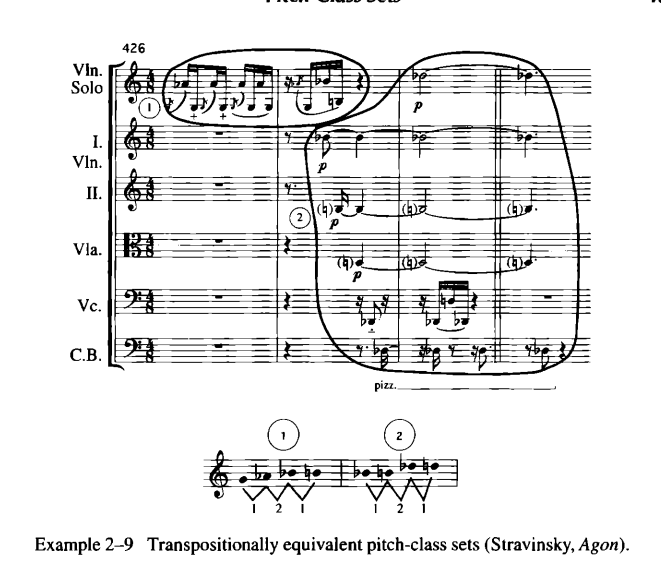
- When two pitch-class sets are related by a Transposition operation, they are said to be transpositionally equivalent.
- Transpositionally equivalent sets contain the same interval classes and therefore have the same Interval Class Vector.
- If you reach in and pull out any two pitch classes, the distances between them will be drawn from the same interval class vector.
Recognizing Sets Related by Transposition
To check whether two sets are related by transposition, compare them in normal form. If the interval succession (the distances between consecutive pitch classes going clockwise) is the same for both, they are transpositionally equivalent. To find the specific Tn, subtract the first element of one set from the first element of the other.
Are [2, 5, 6, 9] and [7, 10, 11, 2] related by transposition?
Subtraction reveals Transposition
A quick way to check for transposition is to subtract the pitch classes of two sets (in normal form). If the difference is always the same number n, then the sets are related by Tn.
| Set B: | 7 | 10 | 11 | 14 (2) |
| Set A: | − 2 | − 5 | − 6 | − 9 |
| n = | 5 | 5 | 5 | 5 |
Since n is constant (5), the sets are related by T5.
Inverse Transposition
If Tn maps Set A onto Set B, then T(12−n) will map Set B back onto Set A.
For example: if T8[5, 7, 8, 11] = [1, 3, 4, 7], then T4[1, 3, 4, 7] = [5, 7, 8, 11], since 12 − 8 = 4.
Nodes, Arrows, and Networks
Many times it is easier to represent sets and the operations that relate them using graphic notation. Draw each set as a node (a circle or box), and connect them with arrows labeled with the operation (e.g., T5).
Transposition Between Pitches
Transposition Between Sets
Make sure to include arrows that show the direction of the operation—T5 going one way is T7 going the other (the inverse transposition).
A Note of Caution
It is possible to be quite "creative" when identifying sets in music and arrive at ludicrous analyses.
Make sure that the sets you identify appear in the music in a way that makes them audible—perhaps they are in the same voice or instrument, members of a verticality (a chord), or are otherwise clearly articulated as a musical unit.
2. Inversion (In)
Inversion is like a mirror. When we invert a pitch class set around 0, we find the mirror pitch class on the other side. You can think of it like a number line, where negative numbers mirror the positive numbers.
Clock Face Intuition
On the clock face, inversion around 0 is easy to see. Think of it as the answer to a question:
"1 o'clock is one hour later than 12 o'clock. What time is one hour earlier than 12 o'clock?"
The answer is 11. So I0(1) = 11.
To generalize this, imagine an axis drawn from 0 to 6 on the clock face. We then map each pitch class to its symmetrical pitch class reflected across the axis.
Worked Examples
Example 1: Invert [0, 1] around 0
Example 2: Pitch classes on both sides of the axis
In this example, 4 and 7 are not on the same side of the 0–6 axis:
Example 3: Invert a major triad [0, 4, 7]
A major triad inverts to a minor triad!
The I0 Formula
You may have noticed a pattern in all of these examples. The operation I0 is simply:
Complete I0 Mapping
| x | 0 | 1 | 2 | 3 | 4 | 5 | 6 | 7 | 8 | 9 | 10 | 11 |
| ↓ | ↓ | ↓ | ↓ | ↓ | ↓ | ↓ | ↓ | ↓ | ↓ | ↓ | ↓ | |
| I0(x) | 0 | 11 | 10 | 9 | 8 | 7 | 6 | 5 | 4 | 3 | 2 | 1 |
Notice: 0 and 6 are fixed points (they map to themselves). Every other pair swaps: 1↔11, 2↔10, 3↔9, 4↔8, 5↔7.
General Formula for Index n:
The index n determines which axis the reflection occurs around. The axis passes through pitch classes n/2 and n/2 + 6 on the clock face.
Why does this matter?
Just like transposition, inversion preserves the Interval Class Vector. A set and its inversion contain the exact same collection of interval classes.
This is why a major triad [0, 4, 7] and a minor triad [0, 5, 8] have the same ICV: they are inversionally related.
3. Combining Inversion & Transposition (TnI)
We can combine inversion and transposition by first inverting a set around 0, and then transposing the result. This combined operation is called TnI.
Two equivalent ways to calculate:
Method 1: Two steps
TnI(x) = First do I0(x), then add n
Method 2: Direct (same as In)
TnI(x) = In(x) = n − x (mod 12)
Worked Example: T3I[0, 4, 7]
Method 1: Invert, then Transpose
Step A: Invert around 0
Step B: Transpose by 3
Method 2: Direct Calculation (I3)
Calculate n − x for each member:
Both methods give the same answer: [3, 8, 11] in normal form. Use whichever feels more natural to you.
Contextual Inversion (Ixy)
There is another way of talking about inversion: Ixy, where x and y are pitch classes that invert onto each other; they may be any pitch classes and they may be the same pitch class.
For example, let's take IGB—that's the inversion that maps G and B onto each other. This specific mapping uniquely identifies the inversion (which happens to be I6). By specifying any one mapped pair, we are simultaneously specifying all of the others. That same inversion also maps C onto F♯, C♯ onto F, D onto E, and D♯ and A onto themselves.
Thus, that same inversion could be called IF♯C, or IAA. All of these labels are equally valid. Which one we choose depends on the specific musical context. One advantage of contextual labels over TnI (or In) is that it does not arbitrarily emphasize inversion around C as 0, which may not have anything to do with the music!
4. Transpose / Invert Lab
Use this tool to explore how sets behave under Tn and In. When you select Inversion, the axis of symmetry is drawn as a dashed line on the result clock face.
Integers or Note Names
Source Set
Result Set
Analysis Report
Invariant Structure CheckOperation
T0
Source ICV
< 001110 >
Result ICV
< 001110 >
Further Study: Graphic Analysis
An analysis of Igor Stravinsky, The Rite of Spring, Introduction to Part One (1913) from The Art of Post-Tonal Analysis: Thirty-Three Graphic Music Analyses by Joseph N. Straus.