Common Tones in Tonal Music
In tonal harmony, common tones are the notes shared between two successive chords. A voice that lands on a common tone doesn't have to move — it can simply hold its pitch while the harmony changes around it. This is one of the oldest tools for smooth voice leading.
Consider a Bach chorale (BWV 9, "Es ist das Heil uns kommen her"). When the bass moves from one chord to the next, the upper voices often hold common tones while the remaining voices move by step. The result is a web of smooth motion held together by shared pitches.
Bach Chorale No. 9 — Common Tones in Voice Leading
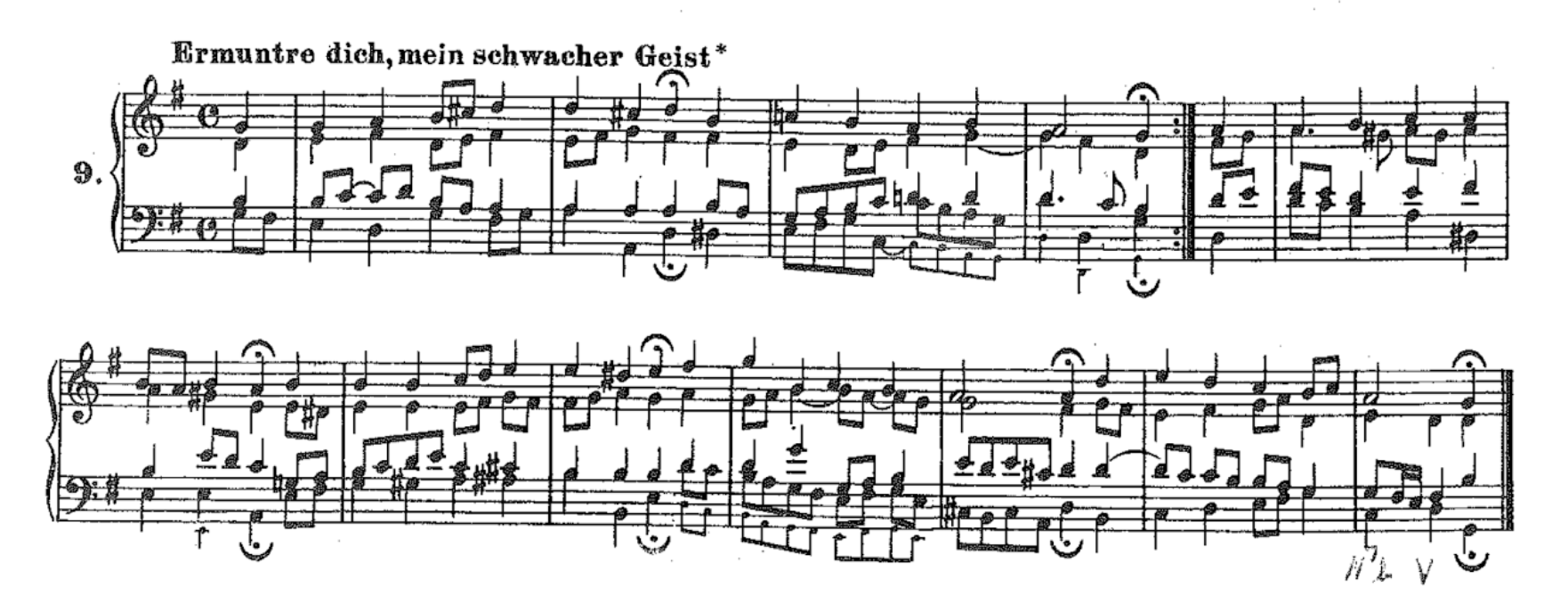
Notice how common tones create a thread of continuity from chord to chord. When the soprano holds the same note across a harmonic change, that's a common tone at work.
The question for this lesson: Does this idea carry over into post-tonal music? When we transpose a set of pitches, can we predict in advance which transpositions will keep notes in common with the original — and how many?
The Same Idea, Post-Tonally
In post-tonal music, instead of chords we work with pitch-class sets — collections of notes treated without regard to octave or spelling. When we transpose a set by some number of semitones, some notes from the original collection may reappear in the new one.
For example: if C major (C–E–G) is transposed up a perfect fifth to G major (G–B–D), the note G is shared — it's a common tone. The other two notes (E→B, C→D) have moved on.
The question is whether there's a quick way to figure this out without comparing every version by hand. As we'll see, the answer is already sitting in the interval-class vector.
Exploring the Major Triad: C–E–G
Let's start with a set everyone knows: the major triad. We'll transpose it by every possible interval (1 through 11 semitones) and count how many notes survive in common with the original C–E–G.
Interactive: Transpose the Major Triad
Try each transposition. Notice which ones keep notes in common and which produce a completely new set of notes.
After trying all eleven transpositions, you'll notice a clear pattern: most transpositions produce zero common tones. Only a handful — specifically those by minor thirds, major thirds, perfect fourths, and perfect fifths — keep any notes from the original. Here's the full picture:
All Transpositions of C–E–G
| Transposition | Resulting Notes | Common Tones | Shared Notes |
|---|
The pitch-class clock below shows the original C–E–G (in blue) alongside T7, a perfect fifth up (in orange). The shared note G appears in green:
The Shortcut: Reading Common Tones from the ICV
There's a beautiful shortcut hidden in something we already know. Recall that the interval-class vector (ICV) counts how many times each interval class appears between the notes of a set.
For C–E–G, the three intervals are: C to E (a major third, IC 4), C to G (a perfect fifth, IC 5), and E to G (a minor third, IC 3):
Transpose by a minor third (IC 3)? Count the 3s in the ICV. Transpose by a perfect fifth (IC 5)? Count the 5s. If the ICV shows a zero, that transposition keeps no notes at all.
Let's check this against C–E–G:
- The ICV shows IC 3 once → T3 (minor 3rd up) and T9 (minor 3rd down) each keep 1 note ✓
- The ICV shows IC 4 once → T4 (major 3rd up) and T8 (major 3rd down) each keep 1 note ✓
- The ICV shows IC 5 once → T5 (perfect 4th up) and T7 (perfect 5th up) each keep 1 note ✓
- All other ICV entries are 0 → those transpositions keep 0 notes ✓
The logic is simple: if two notes in a set are a perfect fifth apart, transposing the whole set by a perfect fifth will "slide" the lower note exactly onto where the higher note was — and that note stays put.
Key Insight
- Each interval in a set corresponds to a transposition that keeps at least one note
- A high ICV entry means that transposition keeps many notes — voices can hold over, moving less
- A zero in the ICV means that transposition keeps nothing — every voice must move
Another Example: C–E♭–F♯ (The Diminished Triad)
Let's try a set with a different structure. The diminished triad C–E♭–F♯ contains two minor thirds (C to E♭, and E♭ to F♯) and one tritone (C to F♯).
Because the minor third appears twice in the ICV, transposing by a minor third should keep two notes. Let's verify:
All Transpositions of C–E♭–F♯
| Transposition | Resulting Notes | Common Tones | Shared Notes |
|---|
T3 (up a minor third) gives E♭–F♯–A. The notes E♭ and F♯ both appear in the original — two common tones, just as predicted. Try all the transpositions below:
Interactive: Transpose C–E♭–F♯
The Special Case: The Tritone
Look back at the diminished triad table. T6 (transposition by a tritone) gives F♯–A–C. Compare with the original C–E♭–F♯: both C and F♯ are shared — that's two common tones. But the ICV shows the tritone (IC 6) appearing only once. Why two tones instead of one?
Rule: For transposition by a tritone (T6), multiply the ICV's tritone entry by 2 to get the number of common tones.
For C–E♭–F♯: the ICV has one tritone (IC 6 = 1), so T6 keeps 1 × 2 = 2 common tones. ✓
Think of it visually: the tritone sits exactly opposite itself on the pitch-class clock. When the whole set "rotates" by six steps, a note and its tritone partner simply swap places — both survive.
Reading Common Tones from the ICV — Complete Rules
- Transpose by IC 1 (semitone/major 7th): common tones = ICV entry for IC 1
- Transpose by IC 2 (whole tone/minor 7th): common tones = ICV entry for IC 2
- Transpose by IC 3 (minor 3rd/major 6th): common tones = ICV entry for IC 3
- Transpose by IC 4 (major 3rd/minor 6th): common tones = ICV entry for IC 4
- Transpose by IC 5 (perfect 4th/5th): common tones = ICV entry for IC 5
- Transpose by a tritone (T6): common tones = ICV entry for IC 6 × 2
Another Example: Set-Class (024) — C–D–E
Let's try one more. Set-class (024) in its simplest form is C–D–E: three notes all connected by whole steps. Its ICV looks quite different from the major triad:
IC 2 (the whole step) appears twice — once for C–D and once for D–E. IC 4 (C–E, a major third) appears once. Everything else is zero.
So the predictions are: transpose by a whole step and keep 2 notes; transpose by a major third and keep 1 note; all other transpositions keep nothing.
All Transpositions of C–D–E
| Transposition | Resulting Notes | Common Tones | Shared Notes |
|---|
Interactive: Transpose C–D–E
Compare C–D–E with C–E–G: the whole-tone set concentrates its common-tone potential on just one interval (the whole step), giving a strong two-note overlap when transposed by that interval. The major triad spreads its common-tone potential more evenly across three different interval classes.
Try Any Set
Enter your own set using pitch-class numbers (C=0, C♯=1, D=2 … B=11) and see how many common tones each transposition produces. Click any row to see it on the pitch-class clock.
Why It Matters
Common tones under transposition matter because of voice leading. When two forms of a set are back-to-back — one the transposition of the other — common tones are the notes that don't have to move. A voice holding a common tone simply stays put while the other voices step to their new pitches. The more common tones, the less total motion in the texture.
This is exactly the same logic as tonal common-tone voice leading (holding G across I–IV in C major), but now applied to any pitch-class set.
In Practice
- Smooth voice leading: Choose a transposition where the ICV entry is high. Those voices hold their notes; only the remaining voices need to move.
- All voices move: Choose a transposition where the ICV entry is zero. There are no common tones — every voice must move to a new pitch. This can create a sense of abrupt change or a clean break between sections.
- Symmetrical sets: Sets like the diminished seventh chord or the whole-tone scale have very symmetrical ICV profiles. Many different transpositions produce the same pitch content — which is why those sonorities can feel harmonically "floating."
A familiar tonal example: the diatonic scale (C major) has six perfect-fifth intervals in its ICV. Transposing it by a perfect fourth (to F major) keeps six out of seven notes — only one note changes (B becomes B♭). That single change is what gives the progression from C to F its sense of gentle harmonic motion rather than abrupt contrast.
Post-tonal composers exploited this systematically. Bartók, Berg, and Webern all built passages where set forms connect through carefully chosen transpositions, creating motivic coherence even when there is no traditional harmonic syntax holding the music together.
Summary
- Common tones under transposition = the ICV entry for that interval class
- Exception: transposing by a tritone always doubles the ICV's tritone entry
- High ICV entry → smooth, connected motion
- Zero in the ICV → maximum contrast, no shared notes
- The ICV lets you plan voice-leading continuity (or deliberate breaks) in advance