Quick Review
Before we get into inversion, let's make sure the core vocabulary is fresh.
A specific note in a specific register — A4 (the A above middle C) is a different pitch from A3 or A5, even though they share the same letter name.
All pitches that share the same letter name across all octaves — plus their enharmonic equivalents — belong to the same pitch class. Every A in every octave, along with G𝄪 and B𝄫 in every octave, all belong to pitch-class 9.
An unordered collection of pitch classes. It tells you which notes are present, not which octave or which order. A minor triad A–C–E is always pitch-class set {9, 0, 4}, no matter how it's voiced.
Play A–C–E in root position, in close position, or spread across several octaves — the pitch-class content is always the same three notes: {9, 0, 4}. The interval distances between them are also always the same:
- A to C: interval class 3 (a minor third)
- C to E: interval class 4 (a major third)
- A to E: interval class 5 (a perfect fifth)
- Interval-class vector: <001110>
The ICV is a fingerprint — it summarizes all the intervals in a set. Transpose or rearrange the set all you like, the fingerprint stays the same.
Moves every pitch class up by n semitones, preserving intervallic structure.
Formula: Tn(x) = x + n (mod 12)
Example: T5 of [0, 4, 7] (C major):
0+5=5 4+5=9 7+5=0
Result: [5, 9, 0] — F major
Reflects each pitch class across an axis of symmetry, creating a mirror image.
Formula: In(x) = n − x (mod 12)
Example: I9 of [0, 4, 7] (C major):
9−0=9 9−4=5 9−7=2
Result: [2, 5, 9] — D minor
How do we know two sets are related by Tn?
Write the two sets one above the other and subtract. If every column gives the same answer, the sets are related by transposition — and that answer is n.
For example: are these two sets related by transposition?
Set B: B–D–E–G (pitch classes 11, 2, 4, 7)
Set A: A–C–D–F (pitch classes 9, 0, 2, 5)
Musical Example: Bartók, Étude Op. 18 No. 1
We'll begin by listening to and looking at the score for Bartók's first piano Étude.
Score: bars 1–2
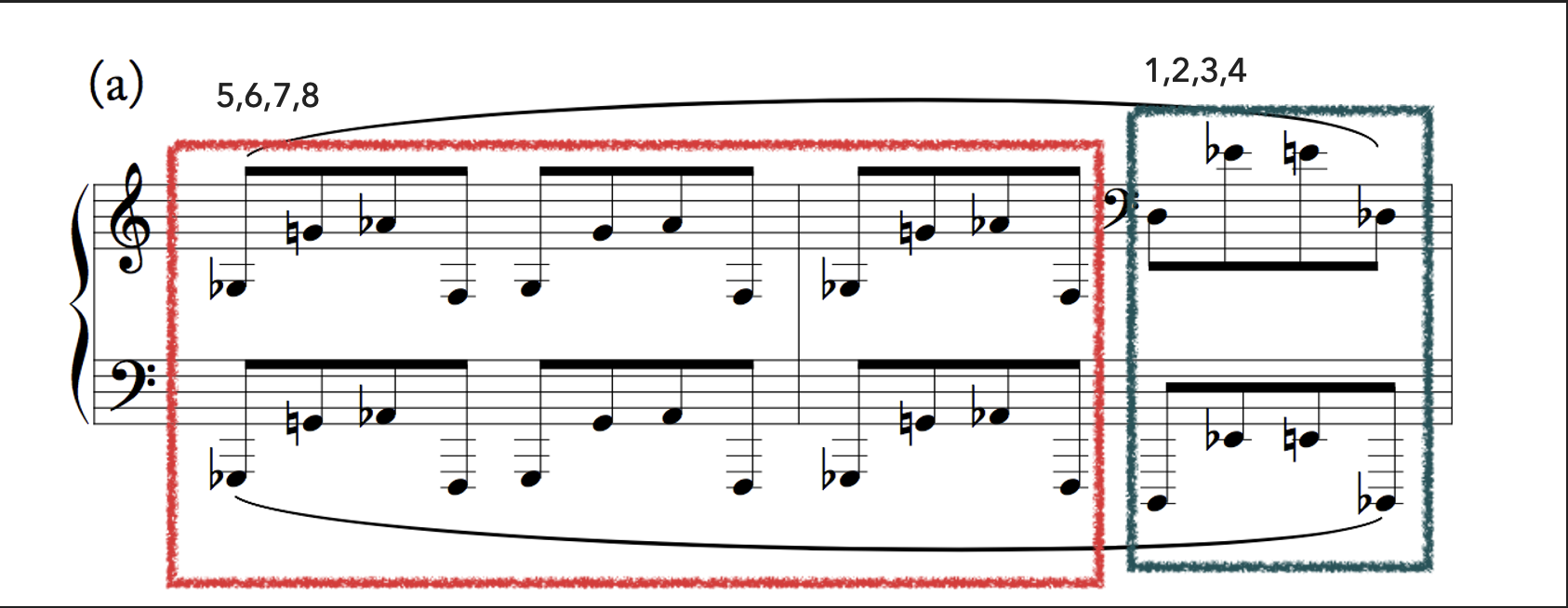
Set A — bar 1 through bar 2 beat 2
F–G♭–A♭–A (pc: 5, 6, 7, 8)
Four consecutive semitones
Set B — bar 2 beat 3
D♭–D–E♭–E (pc: 1, 2, 3, 4)
Also four consecutive semitones
What pitch-classes are used in each? How are they related? The obvious first move is to try subtraction.
Step 1: Try subtraction (check for Tn)
We already know how to check for transposition: subtract one set from the other column by column. If the answer is constant, the sets are Tn of each other.
It works — both are chromatic clusters four semitones apart, so T4 is valid. But listen again to the étude: does the second cluster sound like the first one simply shifted up? Or does it feel more like a reflection?
Bartók places the two clusters at opposite ends of the keyboard — the gesture feels mirrored, not transposed. That suggests we should look for an inversional relationship too.
Step 2: Try addition — remember to cross-pair them
To check for inversion we add instead of subtracting — but because inversion reverses the order of a set, we cross-pair them. Write both sets in normal order, then add first of Set A with last of Set B, second with second-to-last, and so on. If every diagonal pair gives the same sum, the sets are related by In, where n is that sum.
Click to animate the crossing lines on our Bartók sets:
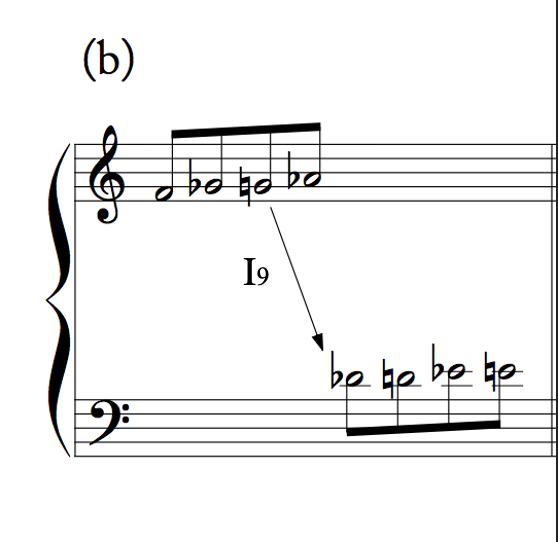
Every diagonal pair sums to 9 → these sets are also related by I9.
Two readings of the same pair
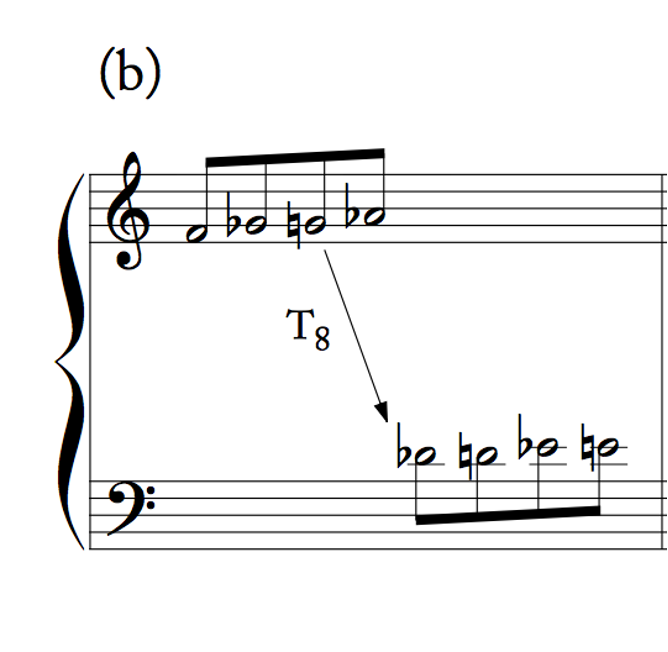
So which is it — T8 or I9? Both are mathematically valid. The score excerpts below show each interpretation:
T8 — transposition reading
I9 — inversional reading
What Bartók is doing
- Both sets are built from four consecutive semitones — they share the same interval content and map onto each other under both T8 and I9. (We will formally define set classes on Wednesday; this one is labeled (0123).)
- In his article, Near-Maximally-Distributed Cycles and an Instance of Transformational Recursion in Bartók's Etude Op. 18, No. 1, Edward Gollin identifies this inversional symmetry as a "structural principle" running throughout the étude: the chordal motive appears consistently as a set paired with its mirror image.1
1 Edward Gollin, "Near-Maximally-Distributed Cycles and an Instance of Transformational Recursion in Bartók's Etude Op. 18, No. 1," Music Theory Spectrum 30, no. 1 (2008): 139–51.
All 12 Inversional Axes and their x/y Labels
Every In has a unique axis of symmetry on the clock face. We can name each inversion by specifying which two pitch classes it maps onto each other — written as Ixy.
The diagram below shows all 12 inversions. Each panel uses curved lines (sometimes called "basketballs" for their shape) to show how pitch classes are paired and exchanged under each In:
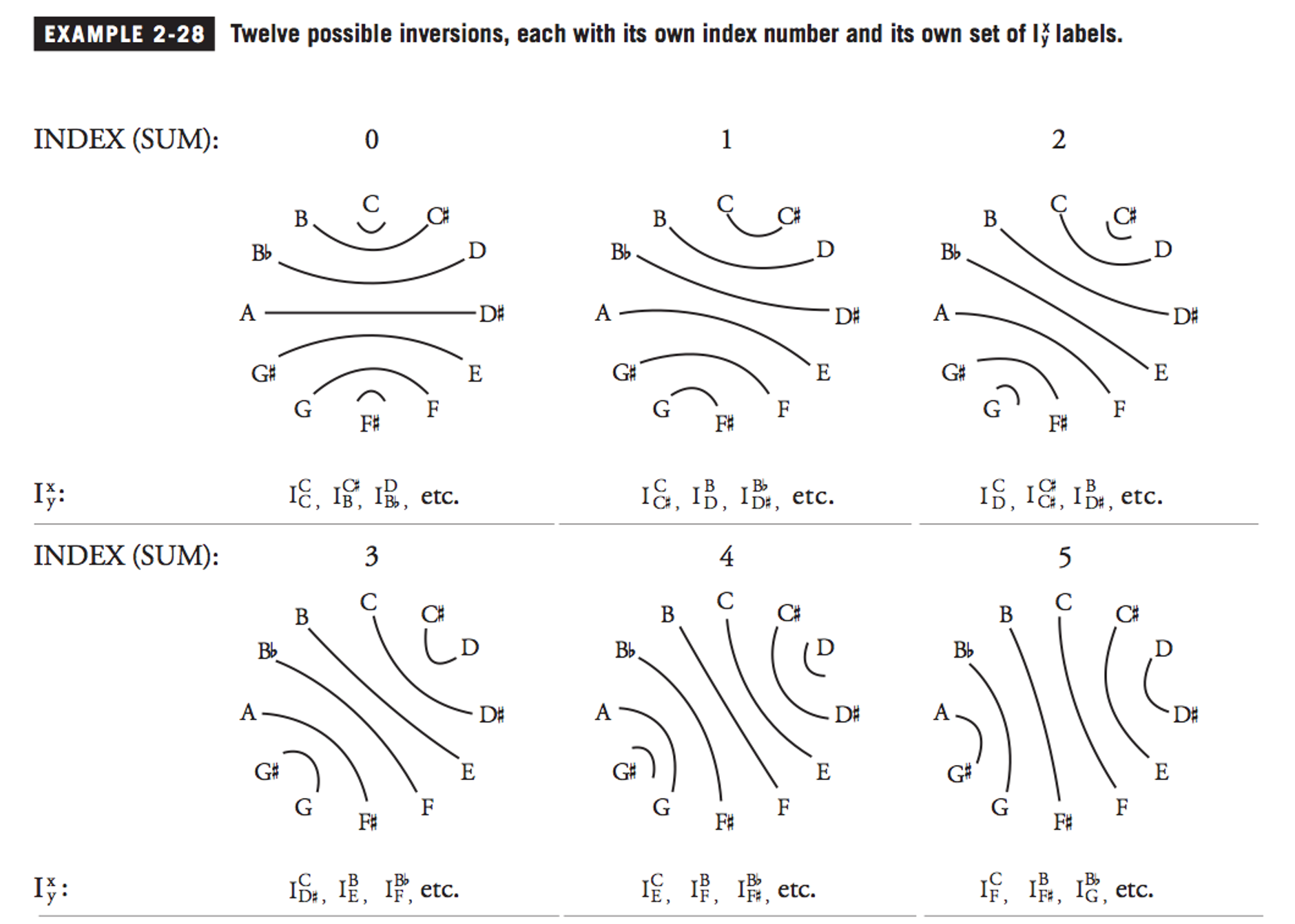
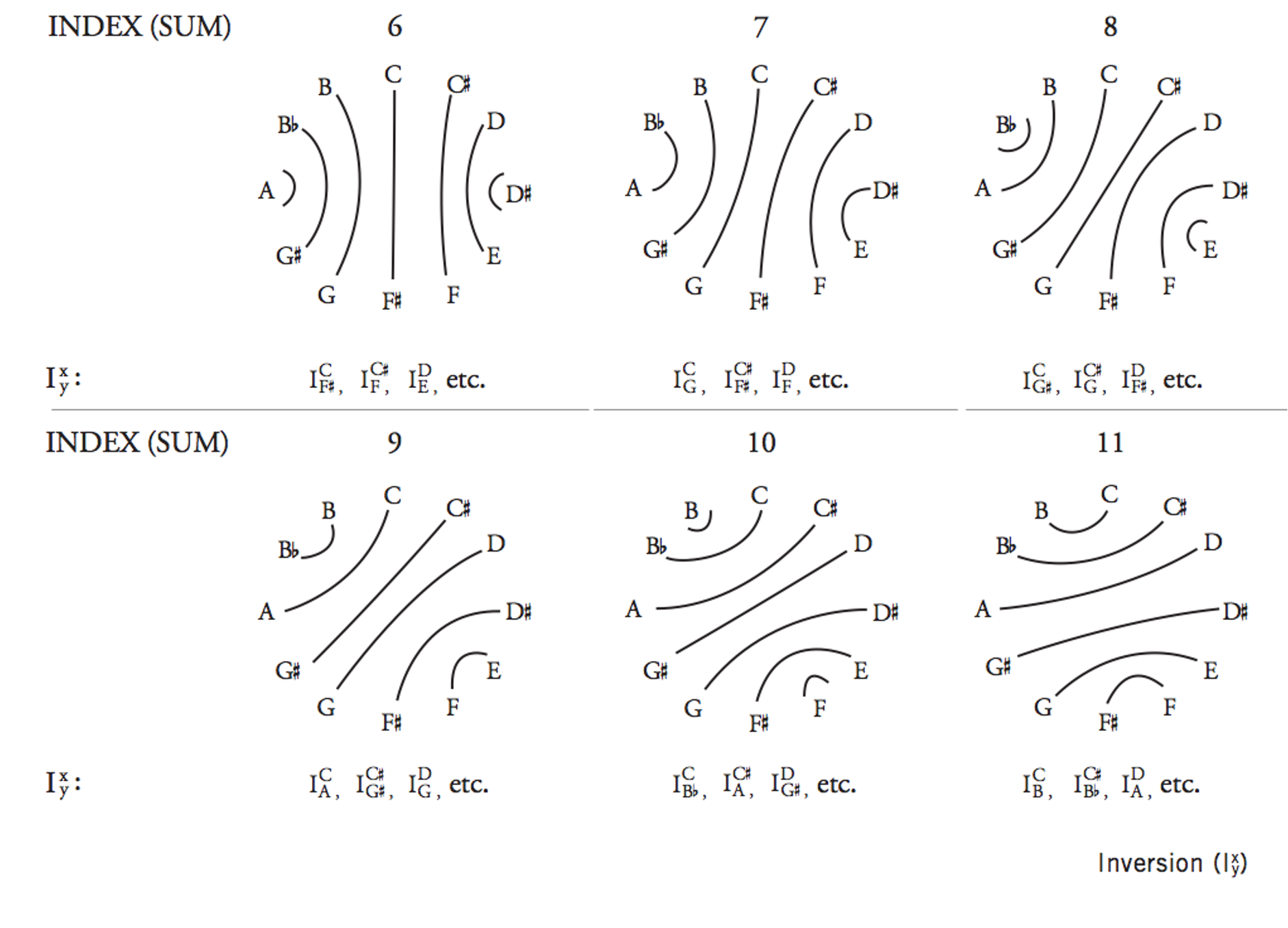
Joseph N. Straus, Introduction to Post-Tonal Theory, 4th ed. (New York: Norton, 2016), Example 2-28.
Click any inversion below to see its axis on the clock:
Select an inversion above to see its axis
Interactive Clock Lab
Use the controls below to explore any inversion. The two clocks show the source set and the result after applying In. The dashed line is the inversional axis.
Numbers or note names (e.g. F, Gb)
Source Set
[ ]
Result Set
[]
Operation
I9
Source ICV
Result ICV
Summary
Transposition moves a set up or down by n semitones, preserving the exact intervallic structure.
Formula: Tn(x) = x + n (mod 12)
Example: Transpose {0, 4, 7} (C major triad) by T5 (up a perfect fourth):
T5(0) = 5 T5(4) = 9 T5(7) = 0
Result: {5, 9, 0} — F major triad.
Check for Tn: write both sets in normal order and subtract column by column. If every column gives the same answer, that answer is n.
Inversion reflects pitch classes across an axis of symmetry, creating a "mirror" image. The index n shifts which axis is used.
Formula: In(x) = n − x (mod 12)
Process: Invert each pitch class, then transpose it. Shortcut: subtract each pitch class from the index number n.
Example: Find I9 of {0, 4, 7} (C major triad):
I9(0) = 9 I9(4) = 5 I9(7) = 2
Result: {9, 5, 2} = {2, 5, 9} — D minor triad.
Check for In: write both sets in normal order and add diagonally (first of A + last of B, second + second-to-last, etc.). If every diagonal pair gives the same sum, that sum is n.
In has an axis — a line of symmetry on the clock face. We can name any inversion by the pitch-class pair that maps onto itself: Ixy.
Bartók's Étude Op.18 No.1: the two chromatic tetrachords (pc 5–8 and pc 1–4) are related by I9 — a mirror image across the A/E♭ axis.
Quick Reference
- Tn(x) = x + n (mod 12) — add n to every pitch class
- In(x) = n − x (mod 12) — subtract every pitch class from n
- Check Tn: subtract sets column by column — constant result = n
- Check In: cross-add sets diagonally — constant result = n
- Both operations preserve the interval-class vector